SEO Basics – Part 4
Off-Page SEO & Link Building
What is Off-Page SEO?
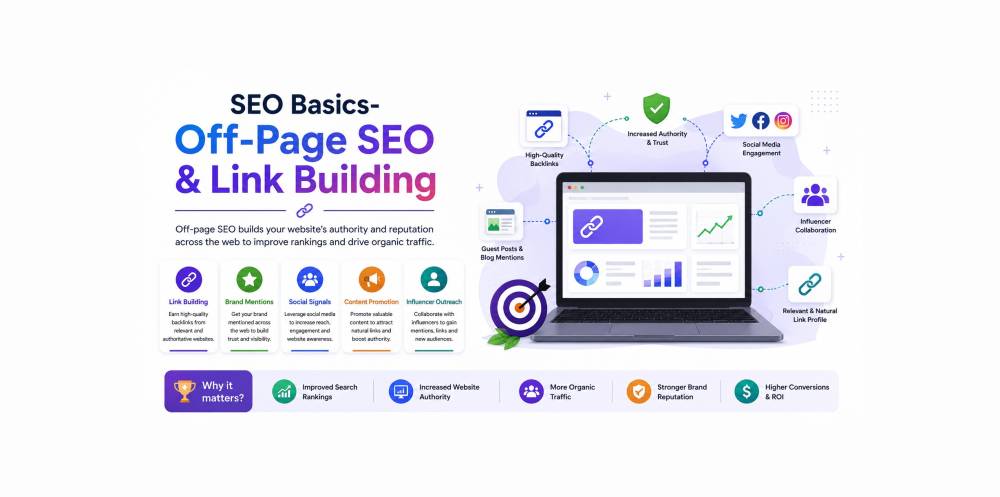
Off-Page SEO refers to all the optimization activities done outside your website to improve its search engine rankings, authority, and trustworthiness. While on-page SEO focuses on content, structure, and technical aspects on your site, off-page SEO deals with signals that show search engines how others perceive your website.
Examples include:
• Backlinks from other websites
• Social media mentions and shares
• Brand mentions
• Influencer outreach
• Forum or community participation
Why it matters:
Search engines use off-page signals to gauge the credibility, authority and popularity of your website. More high-quality backlinks usually mean better rankings
What is a backlink and Its Type ?
A backlink (also called inbound link) is a link from another website pointing to your website. Backlinks act as “votes of confidence” for search engines.
Types of Backlinks:
- Do-Follow Backlinks
- Pass SEO value (link juice) to your site.
- Help improve rankings.
- No-Follow Backlinks
- Do not directly pass link juice.
- Useful for referral traffic and brand awareness.
- Editorial Backlinks
- Naturally placed in content because your content is valuable.
- Guest Post Backlinks
- Links from articles you write on other websites.
- Directory Backlinks
- From online business directories.
- Less effective now unless from high-quality directories.
- Forum or Comment Backlinks
- Placed in forum posts or comments.
- Usually no-follow but can drive traffic.
- Social Backlinks
- From social media platforms.
- Mostly no-follow but helps with visibility.
8.Resource Page Backlinks
- Links from pages that curate helpful resources in a niche.
- High-quality if your content is genuinely useful.
- Example: A university or industry site linking to your tutorial or guide.
9. Image or Infographic Backlinks
- When someone embeds your infographic or image on their site and credits you with a link.
- Often editorial in nature, high-quality, and shareable.
10. Press Release Backlinks
- Links included in online press releases.
- Can drive visibility and traffic, but SEO value is moderate unless picked up by authoritative sites.
11. Profile Backlinks
- Links from user profiles on forums, blogs, or platforms like GitHub, Behance, or Crunchbase.
- Mostly no-follow but can contribute to your digital footprint.
12. Web 2.0 Backlinks
- Links from self-created subdomains on platforms like Medium, WordPress.com, or Blogger.
- Can be useful for niche content promotion, though they carry moderate authority.
13. Contextual Backlinks
- Links embedded naturally within the body of relevant content.
- Considered highly valuable for SEO because they are contextual and relevant.
14. Edu & Gov Backlinks
- Links from .edu or .gov domains.
- Highly trusted by search engines due to the authority of these domains.
- Example: A university citing your research or a government site linking to your guide.
What is a backlink profile and why is it important?
A backlink profile is the collection of all backlinks pointing to your website. It shows search engines and SEO auditors the quality, quantity, and relevance of your inbound links.
Why it’s important:
- Indicates website authority and trustworthiness
- Helps identify spammy or toxic links that can harm rankings
- Guides link-building strategy
- Helps monitor competitors’ backlinks
Components of a healthy backlink profile:
- High-quality backlinks from authoritative sites
- Relevant backlinks (industry-related)
- Diverse anchor texts
- Mix of do-follow and no-follow links
- Low number of toxic or spammy links
What is link juice?
Link juice is a colloquial SEO term for the ranking power or authority passed from one page to another via a hyperlink.
- Think of it as SEO value flowing through links.
- Pages with high authority can boost the ranking of pages they link to.
How does link juice pass between pages?
Link juice flows based on a few rules:
- Do-Follow Links: Pass most of the link juice to the target page.
- No-Follow Links: Generally do not pass link juice (minor exceptions exist).
- Internal Linking: Link juice can flow within your website pages. For example, your homepage passes authority to internal pages through internal links.
- Page Authority Distribution: If a page links to many pages, link juice is split among all outbound links.
- Anchor Text Influence: The anchor text of the link helps search engines understand the topic relevance of the target page.
Example:
If your homepage has high authority and links to 5 internal pages with do-follow links, the link juice from the homepage is distributed among these 5 pages, helping them rank better.
What is link building and why does it matter?
Link building is the process of acquiring backlinks from other websites to your own site. It’s a key part of off-page SEO because backlinks act as votes of confidence for search engines.
Why it matters:
- Improves domain authority and page authority
- Boosts search engine rankings
- Increases referral traffic from other websites
- Enhances brand visibility and credibility
- Helps search engines discover your content faster
Without link building, even the best content may struggle to rank, because search engines use backlinks as a major ranking signal.
What is a dofollow link?
A dofollow link is a hyperlink that passes SEO authority (link juice) from the linking site to the target site.
- It directly influences search engine rankings.
- Most links are dofollow by default unless specified otherwise.
Example: A high-authority blog linking to your site naturally with a dofollow link will boost your ranking.
What is a nofollow link?
A nofollow link is a hyperlink that does not pass SEO authority.
It has the attribute rel="nofollow" in its HTML code.
Search engines don’t count it as a direct ranking vote, but it still has other benefits.
Example: Blog comments, forum links, or sponsored posts often use nofollow tags.
How do nofollow links contribute to SEO strategy?
Even though nofollow links don’t directly pass link juice, they are valuable for:
- Driving referral traffic to your website
- Building brand awareness
- Creating a natural backlink profile (a mix of dofollow and nofollow looks organic to search engines)
- Indirect SEO benefits: Users may share your content, which can lead to new dofollow backlinks
In short, nofollow links help with visibility, credibility, and link diversity, which are important for long-term SEO.
What are natural backlinks versus paid or spammy links?
Natural Backlinks vs Paid or Spammy Links
- Natural Backlinks:
- Earned organically because your content is valuable
- From authoritative and relevant websites
- High trust and SEO benefit
- Paid Backlinks:
- Purchased or exchanged purely for SEO
- Risky if search engines detect manipulation
- Can result in penalties if not done carefully
- Spammy Backlinks:
- From low-quality, irrelevant, or link farms
- Often used in black-hat SEO
- Can harm rankings and website reputation
What is a broken link and how do you fix it for SEO benefit?
A broken link is a hyperlink that points to a page that no longer exists, giving a 404 error.
Why it matters for SEO:
- Broken links negatively affect user experience
- Can waste link juice if internal pages have broken links
- Search engines may reduce crawling efficiency
How to fix:
- Identify broken links using tools like Screaming Frog, Ahrefs, or Google Search Console
- Update the link to the correct URL if content has moved
- Redirect the broken URL to a relevant page using a 301 redirect
- Remove the link if no suitable replacement exists
Fixing broken links helps retain link juice, improve user experience, and maintain SEO value.
How do internal links affect SEO and link juice distribution?
Internal links are hyperlinks that connect one page of your website to another. They serve multiple SEO purposes:
- Crawlability: Search engines use internal links to discover new pages on your site. Pages with more internal links are more likely to get crawled frequently.
- Hierarchy and structure: Internal linking helps define the importance of pages. For example, linking heavily to a product page signals to Google that it’s important.
- Link juice distribution: Also called “PageRank flow,” internal links pass authority from one page to another. A homepage with high authority can distribute some of its link value to subpages via internal links. Proper structuring ensures that important pages get enough link juice to improve rankings.
Pro tip: Use a mix of deep links (to inner pages) and contextual links (within content) to balance link juice distribution.
How does anchor text influence search rankings?
Anchor text is the visible, clickable text of a link. Search engines use it as a signal to understand the context and relevance of the linked page.
- Descriptive anchor text: Tells Google what the target page is about, which can improve ranking for related keywords.
- Natural variations: Using varied anchor text (synonyms, partial matches) looks organic and reduces over-optimization risks.
- Avoid generic anchors for SEO value: “Click here” or “read more” doesn’t convey keyword context.
What is anchor text over-optimization and why is it risky?
Anchor text over-optimization occurs when too many links point to a page using the same keyword-rich anchor text.
Risks:
- Triggers search engine penalties (seen as manipulative link building).
- Appears unnatural to crawlers and users.
- Can cause ranking drops even if the content is relevant.
Best practice: Mix branded, generic, partial-match and exact-match anchors naturally.
What are reciprocal links and should you use them?
Reciprocal links occur when two websites agree to link to each other.
Pros:
- Can drive traffic if the sites are relevant.
Cons:
- Minimal SEO benefit; Google may discount them if they seem manipulative.
- Excessive reciprocal linking is a link scheme and can lead to penalties.
What is link velocity and why does Google track it?
Link velocity refers to the speed at which a website gains backlinks over time.
- Normal link velocity: Natural growth occurs gradually as your content is published, shared or referenced.
- Abnormal link velocity: A sudden spike in backlinks can signal manipulative SEO practices (like buying links).
Why Google tracks it:
Google monitors link velocity to detect unnatural link building and potential spam. Sudden, unnatural spikes can trigger algorithmic penalties or manual reviews.
What is link relevance and its impact on search engine ranking?
Link relevance measures how closely the linking page’s content matches the topic of your page.
- High relevance: A backlink from a site in the same niche (e.g., a fitness blog linking to a running shoe review) carries more authority and improves ranking.
- Low relevance: Links from unrelated sites (e.g., a fashion blog linking to industrial machinery) have minimal SEO value and may look suspicious.
Impact: Relevant links help Google understand your website’s niche, boosting topical authority and rankings.
What are PBNs (Private Blog Networks) and why are they risky?
PBNs are networks of websites created solely to build backlinks to a target site.
Why they’re risky:
- Google actively penalizes sites using PBNs.
- They often use expired domains or low-quality content.
- If detected, your site can face manual penalties, causing significant ranking drops.
Best practice: Avoid PBNs entirely; focus on natural and high-quality backlinks.
How do low-quality backlinks affect SEO?
Low-quality backlinks include:
- Spammy directories
- Link farms
- Irrelevant sites
- Sites with thin or auto-generated content
Negative effects:
- Can trigger Google’s Penguin or manual penalties
- Dilute your link profile and reduce authority
- May lower rankings instead of improving them
Tip: Audit your backlinks regularly to maintain a healthy profile.
How can you remove toxic or harmful backlinks?
- Manual outreach: Contact the webmaster and request link removal.
- Disavow tool: Submit a list of harmful links to Google via Search Console’s disavow tool.
- Regular audits: Use tools like Ahrefs, SEMrush, or Moz to identify low-quality links.
Important: Only disavow links that you can’t remove manually; otherwise, removal is preferred.
What is guest posting and how does it help with link building?
Guest posting is creating content for another website in your niche, usually with a backlink to your site.
Benefits:
- Builds high-quality, relevant backlinks
- Increases brand exposure and referral traffic
- Positions you as an authority in your niche
Best practice: Focus on authoritative sites with engaged audiences; avoid spammy guest post networks.
How do outbound links to authoritative sites impact rankings?
Linking to high-authority, relevant websites can improve your SEO in several ways:
- Trust and credibility: Google sees that you reference reliable sources, which can boost your site’s authority.
- Contextual relevance: Outbound links help search engines understand your content topic more clearly.
- User experience: Providing useful references adds value for readers, indirectly helping rankings.
Tip: Only link to authoritative and relevant sites; avoid excessive or unrelated outbound links.
What is link reclamation strategy?
Link reclamation is the process of recovering lost or broken backlinks that once pointed to your site. It includes:
- Finding broken links or mentions of your brand without links.
- Contacting webmasters to fix or add the link.
- Replacing outdated URLs with current ones.
This strategy helps regain lost link equity, improve rankings, and strengthen your backlink profile.
What is semantic relevance between linking pages?
Semantic relevance refers to how closely the content of the linking page relates to the target page’s topic.
- Links from semantically relevant pages (even if the exact keyword isn’t used) carry more SEO value.
- Google uses semantic analysis to understand topic context, so a link from a related niche signals authority better than a link from a completely unrelated site.
Example: A blog about “healthy diets” linking to a page on “meal prep for weight loss” has high semantic relevance.
Author Bio
Ketan Kathane is an SEO Executive at Technogaze Solutions with 2 years of hands-on experience in search engine optimization, content strategy and digital marketing. Passionate about helping businesses improve their online visibility, Ketan specializes in crafting SEO-friendly strategies that drive traffic, engagement and conversions. He keeps up with the latest trends in SEO and digital marketing to ensure businesses stay ahead in the competitive online landscape.