SEO Basics – Part 1
Introduction
When you are learning about SEO basics or about to attend any interview related to SEO, the first step is to understand the basic concepts. Generally, no company wants to hear about complex concepts at the initial stage. They want to know how well you understand the SEO fundamentals and how well you can explain it. This blog by TechnoGaze is aimed at providing you with this information about important SEO interview questions along with SEO questions and answers.
What is SEO?
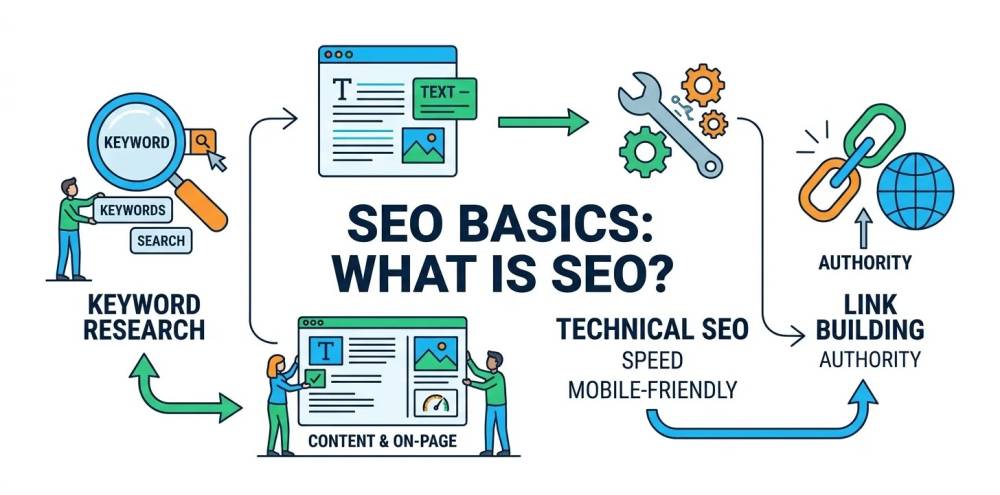
SEO (Search Engine Optimization) is the process of improving a website’s visibility on search engines like Google, Bing or Yahoo. The goal is to rank higher in the search engine results pages (SERPs) so that more organic (non-paid) traffic visits your website.
SEO involves optimizing multiple aspects of your website and online presence, such as:
• On-page SEO: Content, meta titles, meta descriptions, headings, images, URL structure and internal linking.
• Off-page SEO: Backlinks, social signals and other external factors that show your website’s authority and trustworthiness.
• Technical SEO: Website speed, mobile-friendliness, site architecture, structured data and secure connections (HTTPS).
In short, SEO is about making your website easy for both users and search engines to understand, navigate and trust.
Why is SEO important to businesses?
SEO is very important for businesses because it helps them get noticed online and reach the right customers. For example, if someone searches for “best pizza in Bhopal,” a restaurant with good SEO is more likely to appear at the top of Google, bringing more visitors to their website or store.
Some important points about why SEO matters:
• Increase Organic Traffic: SEO brings people who are already looking for your products or services, without paying for ads.
• Build Trust and Credibility: Websites that appear on the first page of Google are seen as more trustworthy by users.
• Cost-effective Marketing: Unlike paid ads, SEO works long-term and keeps bringing traffic without recurring costs.
• Better User Experience: SEO improves website speed, mobile-friendliness and easy navigation, making it user-friendly.
• Stay Ahead of Competitors: Businesses with strong SEO outrank competitors and get more visibility online.
What are keywords?
Keywords are words or phrases that users type into search engines when looking for information, products or services.
For example, if someone wants to buy a laptop, they might search:
• “Best laptops under 50,000”
• “Gaming laptops 2025”
What are long-tail and short-tail keywords?
Short-tail keywords (also called “head keywords”) are short, general search terms, usually 1–3 words.
• Example: “Laptop” or “Shoes”
• Pros: High search volume
• Cons: Very competitive, less specific, harder to rank
Long-tail keywords are longer, more specific phrases, usually 3–6 words or more.
• Example: “Best gaming laptops under 50,000 in India”
• Pros: Less competitive, highly targeted, higher chance of conversion
• Cons: Lower search volume
Key difference: Short-tail brings more traffic but less targeted, while long-tail brings less traffic but more qualified leads likely to convert.
What is search intent?
Search intent (also called “user intent”) is the purpose behind a user’s search query what they are really looking for. Understanding search intent helps create content that meets users’ needs, which improves ranking and engagement.
There are generally four main types of search intent:
1. Informational: The user wants to learn or find information.
o Example: “What is SEO?”
2. Navigational: The user wants to reach a specific website or page.
o Example: “Facebook login page”
3. Transactional: The user intends to make a purchase or take an action.
o Example: “Buy iPhone 15 online”
4. Commercial/Investigational: The user is researching before making a purchase decision.
o Example: “Best smartphones 2025 reviews”
Matching your content to the correct search intent is critical for SEO success because even high-ranking content may fail if it doesn’t satisfy the user’s purpose.
What is keyword frequency, keyword density, keyword difficulty and keyword proximity?
Keyword Frequency:
This refers to how many times a specific keyword appears in a piece of content. For example, if your article mentions "Graphic Design Course" 10 times, the keyword frequency is 10. Higher frequency can signal relevance to search engines, but overuse can lead to keyword stuffing.
Keyword Density:
Keyword density is the percentage of times a keyword appears compared to the total number of words in the content.
Example: If a 1,000-word article uses the keyword 10 times, the density = (10 ÷ 1000) × 100 = 1%.
SEO best practice: Maintain a natural keyword density of around 1–2%; anything higher may appear spammy.
Keyword Difficulty:
Keyword difficulty measures how hard it is to rank for a specific keyword on search engines. High difficulty keywords are very competitive (like “Best SEO Tools”), while low difficulty keywords are easier to rank for, often long-tail terms (like “Affordable SEO tools for small businesses”).
Keyword Proximity:
This is about how close keywords are to each other in the content. Search engines may give more importance if keywords appear close together in sentences or headings.
Example: “Graphic Design Course in Bhopal for Beginners” the words “Graphic Design” and “Course” are close, improving relevance.
What is keyword cannibalization?
Keyword cannibalization happens when multiple pages on your website target the same keyword. Instead of one strong page ranking, your pages compete against each other, weakening overall SEO performance.
Example: If you have two blog posts targeting “Graphic Design Course in Bhopal,” Google may struggle to decide which page to rank, resulting in lower positions for both.
Fix: Consolidate pages, use canonical tags, or target slightly different keywords for each page
What is keyword prominence (first 100 words rule)?
Keyword prominence means placing your primary keyword in prominent positions, especially within the first 100 words of your content. This helps search engines quickly understand the topic of your page.
Example: In a blog about “Graphic Design Courses,” mention this exact keyword in the opening paragraph or first heading.
Benefit: Improves SEO because search engines often give more weight to keywords appearing early in the content.
What is keyword stemming and why does it matter?
Keyword stemming is using variations of your main keyword to capture a wider range of search queries.
Example: If your main keyword is “Graphic Design Course,” stemmed variations include:
• “Graphic Design Courses”
• “Graphic Designing Course”
• “Learn Graphic Design”
Why it matters:
• Helps your content rank for multiple related searches.
• Avoids keyword stuffing by naturally including variations.
• Enhances content relevance in search engines.
Should you focus on zero search volume keywords?
Zero search volume keywords are those that show no measurable monthly searches in keyword tools.
• Pros:
o Less competition → easier to rank.
o Can attract highly targeted visitors looking for specific content.
• Cons:
o Might not bring significant traffic.
o Risk of focusing too much on irrelevant terms.
SEO Approach: Use zero search volume keywords strategically in combination with higher-volume keywords, especially for niche topics or long-tail variations.
Author Bio
Ketan Kathane is an SEO Executive at Technogaze Solutions with 2 years of hands-on experience in search engine optimization, content strategy, and digital marketing. Passionate about helping businesses improve their online visibility, Ketan specializes in crafting SEO-friendly strategies that drive traffic, engagement and conversions. He keeps up with the latest trends in SEO and digital marketing to ensure businesses stay ahead in the competitive online landscape.